In linear algebra an eigenvalue of a (square) matrix  is a number
  that satisfies the eigenvalue equation,

where det means the determinant,  is the identity matrix of the same dimension as ,
and in general can be complex.
The origin of this equation, the characteristic polynomial of A, is the eigenvalue problem, which is to find the eigenvalues and associated eigenvectors of .
That is, to find a number and a vector
is the identity matrix of the same dimension as ,
and in general can be complex.
The origin of this equation, the characteristic polynomial of A, is the eigenvalue problem, which is to find the eigenvalues and associated eigenvectors of .
That is, to find a number and a vector  that together satisfy

What this equation says is that even though is a matrix its action on is the same as multiplying the vector by the number .
This means that the vector and the vector  are parallel (or anti-parallel if is negative).
Note that generally this will not be true. This is most easily seen with a quick example. Suppose
are parallel (or anti-parallel if is negative).
Note that generally this will not be true. This is most easily seen with a quick example. Suppose
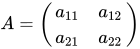 and
and 
Then their matrix product is

whereas the scalar product is
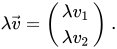
Obviously then  unless
 and simultaneously
  .
For a given , it is easy to pick numbers for the entries of and such that this is not satisfied.
.
For a given , it is easy to pick numbers for the entries of and such that this is not satisfied.
The eigenvalue equation
So where did the eigenvalue equation  come from? Well, we assume that we know the matrix and want to find a number and a non-zero vector so that
  . (Note that if
  then the equation is always true, and therefore uninteresting.) So now we have
 . It doesn't make sense to subtract a number from a matrix, but we can factor out the vector if we first multiply the right-hand term by the identity, giving us
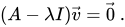
Now we have to remember the fact that  is a square matrix, and so it might be invertible.
If it was invertible then we could simply multiply on the left by its inverse to get
is a square matrix, and so it might be invertible.
If it was invertible then we could simply multiply on the left by its inverse to get

but we have already said that can't be the zero vector! The only way around this is if is in fact non-invertible. It can be shown that a square matrix is non-invertible if and only if its determinant is zero. That is, we require
which is the eigenvalue equation stated above.
A more technical approach
So far we have looked eigenvalues in terms of square matrices. As usual in mathematics though we like things to be as general as possible, since then anything we prove will be true in as many different applications as possible. So instead we can define eigenvalues in the following way.
Definition: Let  be a vector space over a field
  , and let
  be a linear map. An eigenvalue associated with is an element
  for which there exists a non-zero vector
  such that

Then is called the eigenvector of associated with .



