In mathematics, a Lucas sequence is a particular generalisation of sequences like the Fibonacci numbers, Lucas numbers, Pell numbers or Jacobsthal numbers. Lucas sequences have one common characteristic: they can be generated over quadratic equations of the form:  with
with  .
.
There exist two kinds of Lucas sequences:
- Sequences
 with
with 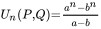 ,
,
- Sequences
 with
with  ,
,
where  and
and  are the solutions
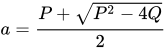
and
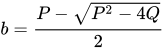
of the quadratic equation  .
.
Properties
- The variables and
 , and the parameter
  and
and  are interdependent. In particular,
  and
and  .
.
- For every sequence it holds that
 and
and  .
.
- For every sequence is holds that
 and
and  .
.
For every Lucas sequence the following are true:




 for all
Recurrence relation
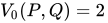
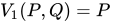
The Lucas sequences U(P,Q) and V(P,Q) are defined by the recurrence relations
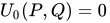
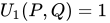

and

Fibonacci numbers and Lucas numbers
The two best known Lucas sequences are the Fibonacci numbers  and the Lucas numbers
  with
with  and
and  .
.
Lucas sequences and the prime numbers
If the natural number  is a prime number then it holds that
- divides

- divides

Fermat's Little Theorem can then be seen as a special case of divides  because
  is equivalent to
  .
.
The converse pair of statements that if  divides
  then is a prime number and if
  divides
  then is a prime number) are individually false and lead to Fibonacci pseudoprimes and Lucas pseudoprimes, respectively.
Further reading



