Quantum fluids
Jump to navigation
Jump to search




A quantum fluid is a fluid where the mean distance between the particles is less than or comparable to the thermal de Broglie wavelength
- ,
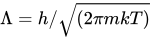
where
- is Planck's constant
- is the mass of the particles of the fluid
- is the Boltzmann constant and
- is the absolute temperature.


In such a case there is a strong overlap of wave functions of adjacent particles and hence quantum statistics (Bose-Einstein or Fermi-Dirac) is applicable. This often results in unusual observable macroscopic phenomena, such as superfluidity, superconductivity and other 'super' transport phenomena.
Reference
- The extraordinary phases of liquid He. Nobel lecture by D.M.Lee.
